from Men's Gear
Franz-Josef Baur — or FJBAUR as he is more commonly known — is a conceptual German pop artist who seeks to find beauty in the mundanity of everyday experiences and showcases it through his own special lens of vividly unadulterated expression. Having spent a portion of his youth and teenage years in the south of Germany, which had a fundamental impact on his artistic expression, Franz-Josef Baur would spend some time training as a chef only to return to his first love of art and become one of Europe’s most vibrant and innovative artists. The artist now calls Vienna and Berlin home taking inspiration from museums and art galleries both in Vienna and across Europe. The elusive artist meets with LUXUO to speak on all things art and unveils what he has planned for 2024.

Life, in its vibrancy and enchantment, offers endless opportunities that one should always embrace. The foundational years of my childhood in Germany are the base layer of my character, which evolved through youthful exploration—both refining and deconstructing my perceptions—leading to a mature appreciation and love for art in my later years.
I love working with different materials, whether it’s resin, plastic, wool, fabric, or paper. Currently, I have a preference for natural materials. I trust serendipity in my selection process; it has to feel right, and then that’s the material I choose for each creative phase.

Absolutely, my latest project is a vivid reflection of that philosophy. It is a newspaper series that draws fresh inspiration from the natural world.
Normally I would say pink is my colour, but over the years, my exhibitions at Art Basel Miami have drawn me towards the enchanting pastels of South Florida, and this affinity continues into 2024. This year, I find myself particularly drawn to a vibrant, saturated “Miami Blue” that captures the exuberance and dynamic spirit of the place.

My work is deeply influenced by the details and emotions found in daily experiences, capturing the essence of life’s moments that often go unnoticed, and it’s underpinned by confidence in my personal vision and artistic intuition.

When viewers encounter my art, I hope they feel a profound sense of unadulterated happiness, as if they’re being immersed in the pure, vivid joy that colours can evoke.
Read More: FJBAUR Presents The Mid-Point Between Art, Design and Fashion in Vienna
I strive to illuminate the core values of compassion and mindfulness that are often overshadowed in our fast-paced, modern society. Through my art, I aim to encourage reflection and a reconnection with those fundamental human values that foster a caring community and enrich our lives beyond material success.

I thrive on interaction and exchange. While I don’t have a team of builders, the creative process is enriched by a continuous dialogue, which informs and inspires my work.
In 2024, I will focus intensively on creating sculptural works. I aim to play with vibrant colors and expressive forms

Each year, I dedicate myself to realising one dream project, and for 2024, my focus has been on a daily collection of materials that has spanned the entire year. This meticulous process is infused with a deep sense of local identity. Through this endeavor, I’m not just creating art but also weaving a narrative that captures the spirit of the city day by day.

Daniel Buren has recently been an inspiring figure, with his distinctive modern and minimalistic style. His approach is characterised by a strong conceptual framework that challenges the traditional boundaries of art, merging the aesthetic with the social and engaging with the urban landscape in a way that is both international and free-thinking.

The entire art “system” can indeed be restrictive, bound by unspoken rules that seem elitist and arrogant, dictating what is recognised as ‘valid’ art. However, the landscape is shifting, opening up numerous opportunities for artists to exhibit work in unconventional spaces. Recently, I was asked to show some works on the billboards of NYC Times Square which I see as a testament to this evolution, affirming my belief that art is transcending the confines of traditional gallery spaces.
Evoking emotions in the viewer and prompting them to pause for a moment. Through my art, I aim to provide an opportunity for people to reflect on what they see and engage with their own emotions. It deeply fulfills me when my works establish a connection and leave a lasting impression.

I primarily do online sales, using Instagram and other social media platforms to showcase and sell my artwork. Art enthusiasts and readers interested in purchasing my works can reach out to me through these channels, and they are welcome to contact me at any time for further inquiries or to make a purchase.
I can’t name just one! But the Tate Modern, with its imposing architecture and avant-garde contemporary art exhibitions, never fails to leave me in awe. The combination of the museum’s striking building design and its thought-provoking displays of modern and contemporary art makes it a must-visit destination for anyone passionate about artistic innovation and expression.
The MAK (Museum of Applied Arts) and the Heidi Horten Museum are two of my favorite collections in Vienna. These museums resonate with me deeply as they uniquely showcase an extensive array of Pop Art and Experimental Art.

Generosity unlocks the fullness of life. If you give love, love comes back.
In my journey as an artist, I’ve discovered that generosity is not just a moral choice, but a creative one too. Sharing my work openly, engaging, and supporting fellow artists has not only enriched my own experience but also expanded the reach and impact of my art. To give freely of ourselves, our time, and our talents, we open up avenues for new inspiration, collaboration, and ultimately, a deeper connection with our audience and the world at large.
To discover more about FJBAUR and his artwork, head to his Instagram and website.
For more on the latest in art reads from across the globe, click here.
The post The Mystic, Materials and Mantra of Artist Franz-Josef Baur appeared first on LUXUO.

When one thinks of Bell & Ross, two names immediately come to mind: Bruno Belamich and Carlos Rosillo, who are of course the Bell and Ross of the brand name. Of course, you are much more likely to meet Rosillo than you are to meet Belamich, for example, and there are plenty of watchmaking brands where only a handful of people ever speak with the media. One even. Bell & Ross is not that kind of watchmaker, as Managing Director Fabien Nonancourt reminds us merely with his presence!

Appointed Head of Sales in 2010, Nonancourt is no stranger to the press, retailers, and collectors in this and other regions. However, it was likely when he took on the General Manager (a term apparently used interchangeably with Managing Director) portfolio in 2017 that his public profile began to grow. While Rosillo is the CEO of Bell & Ross and Belamich is the Creative Director, Nonancourt’s influence is perhaps most strongly felt on the front end of the brand experience. He has been heavily involved in what the brand calls the “optimisation,” of its 600 points of sale worldwide and has most recently been engaged in developing the brand’s network of boutiques in Asia and Australia. As a member of the senior management team, Nonancourt is certainly in the mix as far as product development is concerned (he is part of the weekly product development meetings in Paris), as he is likely to be one of the first people to learn what people think of the watches and, crucially, to receive feedback from the sales floor.
On a recent visit to this region, Nonancourt went through the most recent update to what is arguably Bell & Ross’ most popular line, the BR 03. Literally a small change, we could not figure out exactly how a one mm difference could be a big deal – no pun intended. Nonancourt was only too happy to tell us how much of a difference it makes.
We felt the demand from the market for smaller watches so we had to find basically the best compromise by reducing slightly the size but not giving up on the strong DNA of the BR 03, which is an instrument with a (strong) shape. We are debuting eight models, six of which already exist, in 41mm (42mm was standard for the BR 03 – Ed>. So this means we have two new designs and we think we have achieved the perfect compromise in delivering the new size. By the way, it is not just the size that has changed; we have made the watches more sophisticated and more refined. We have rounded the corners slightly and the lugs are a little bit smaller, as you noticed. So a lot of little changes make a big difference at the end of the day.

Read More: Bell & Ross’ BR 03-Cyber-CE Hits All the Right Angles
I mean, you can really say size matters, even if just 1mm or 1/2mm millimeter; you can clearly see the difference <and feel it too – Ed>. And I can tell you, Bruno Belamich did so many prototypes with the different sizes of lugs and trying to have different (proportions) also of the rounded corners to find the perfect shape. The straps are also different (a result of the lug-width change) and the buckle is smaller too. This (evolution) has been the result of intense studies and difficult choices because (as mentioned), these are very small differences that make a big impression. Remember that way back when, some people would tell us that they love the BR 03 (and the BR 01 too) but that it was too big, too instrument-like, and too difficult to wear. So that is why we have created in 2019, the BR 05, which is another interpretation of the flight instrument, but in a more urban way that is suitable for any occasion.
So, the BR 05 was partly an answer to those clients, who are from everywhere…it is not the case that it was clients in Asia who wanted a smaller size. The smaller watch trend is everywhere, even in the US where they historically have liked small watches (including Bell & Ross models now out of production). In the watch industry, there are always trends with regard to size. Before, it was for larger watches, now it is for smaller watches. I think maybe people now want to be a little bit less ostentatious with their watches. It’s a little bit strange because at the same time, maybe people are willing to spend more and more money on watches! The BR 05 (for example) is a luxury sports watch.

First of all, there was the choice of the size and that was the first decision (with regards to the BR 03). There was part of the team that was scared to change this historical model because Bell & Ross was known for the 42mm size. I think the strength of this product is to have a bigger size; I mean we had also the BRS collection that was 39mm and that was not so successful. So the (new size for the BR 03) was a big, big decision. And when we compared the 40mm prototype to the 41mm one, we felt better with the 41mm one.
Even though it was smaller (than the 42mm original), but you can still feel the strength of the instrument design aesthetic immediately. Also, a 2mm change is quite big on the square watch form <referring to why the 40mm prototype was not chosen>; we did show the 41mm prototype to (selected collectors and retailers) who said the 42mm BR 03 was too big and they liked it. (As I said), a 1mm change makes a huge difference in perception (with the specific Bell & Ross instrument style of watch).

We don’t want to surprise people too much or to make a revolution. It is like, you know, the Porsche 911 – it should always be the 911; Porsche is not going to make revolutionary changes to the car. The BR 03 has been a bestseller for us since the beginning, and these watches will continue to be the bestsellers. People do not expect to see a totally new BR 03. They expect to see the product that they know but with some improvements, like we are now using the latest movement so we have a 54-hour power reserve.
As far as a surprise goes, we have the BR 03- 94 Blacktrack chronograph (co-created with designer Sacha Lakic) which is in the motorsports arena <see Highlights this issue – Ed>.

This is how we work with Kenissi, which makes a tough and reliable movement for us in the BR-CAL.323. Our main priority in pursuing the manufacture movement was to be more present, let’s say, with those brands going with in-house or manufacture movements. I think here there is a demand from the market for manufacture movements…I don’t think that collectors are strictly looking for manufacture movements (per se). They’re looking for the benefit of the manufacture movement. Bell & Ross is a strong name (in watchmaking) known for its design (expertise) and we wanted to offer something with a manufacture movement…but not at crazy prices. Yes, the BR-X5 is more expensive than the 03 and 05 collections but not by (too large an amount) for an improvement in power reserve to approximately 70 hours. There are also other benefits, like extended warranties, that add value to the final watch (as far as benefits that manufacture movements offer).
So (the manufacture movement for the X5) was our first move and it has been very, very successful. We will continue to extend the collection to be part of the manufacture movement world (as Rosillo and Belamich have spoken about). I mean, this is not for tomorrow but it is part of the plan (for the future). (But the manufacture movement) will not be limited to just this collection…we plan to eventually bring the manufacture movement to the BR 03.

Read More: Aeronautical Acrobat: Bell & Ross BR 03-92 Patrouille de France 70th Anniversary

You know, when we launched, I was not working for Bell & Ross at that time (the company was founded in 1992 – Ed). Bell & Ross launched its first vintage collection in 1997, and it was probably the first brand in the entire watch industry to launch a product called “Vintage.” Today, everyone is doing something vintage, but to launch in 1997 a brand new model that is called Vintage, not to have reissues of vintage watches, we were really ahead of the trend. I mean it was Bruno’s inspiration and his feeling of the market that led him to think that maybe we should do a revival of the designs from the 1940s and the 1950s. Bell & Ross was alone at that time to do this. In fact, the name “Vintage” officially belongs to us…Bell & Ross has a trademark on the “Vintage” name; others are now doing reissues from their own back catalogues but no one can name these watches “Vintage.” Initially, this really helped us stand out but today, now that everyone is doing it, there is not such an advantage anymore.
This article first appeared on WOW’s Festive 2024 issue.
For more on the latest in watch reads, click here.
The post Why Size Matters at Bell & Ross appeared first on LUXUO.

Following the arrival of Asia’s first wallywhy200 in Singapore last year, Wally is set to enjoy an even higher profile in the region this year with the arrival of at least two units of the new wallywhy150.
Since debuting in Italy at last year’s Venice Boat Show, the 24m wallywhy150 earned plaudits in France at the Cannes Yachting Festival, Europe’s biggest in-water show, before making its US bow at the Fort Lauderdale International Boat Show, the world’s biggest.
Coming up this year is the model’s Asia premiere, with hull two expected to be delivered in May after being sold by Speedo Marine to a client who plans to use it between the likes of Shenzhen and Hong Kong. As on hull one and most subsequent builds, hull two will feature the wallywhy200-inspired main-deck master suite, which offers 270-degree views around the towering bow.

However, the space will be used for a dining room on Asia’s next hull, which is scheduled to arrive in Hong Kong through Ferretti Group Asia Pacific in late summer. Both units destined for Asia have the upgraded option of three Volvo Penta D13-IPS1350 (1000mhp/735kW) engines, which give the yacht a top speed of 23 knots, a cruising speed of 20 and a 1,000nm range at 10 knots.
Stefano de Vivo, Wally’s Managing Director, said: “Our goal was to anticipate market demands by developing a yacht capable, once again, of being ahead of its time, starting from those innovative features that made the wallywhy200 successful.
“The wallywhy150 is a flexible yacht, ideal for experienced owners who understand and appreciate the skilful use of space, considerable living areas and its unmistakable personality. We’re sure the wallywhy150 will establish itself in the most diverse international markets.”

Look from the side and the 78ft wallywhy150 looks much like the 88ft wallywhy200, with an almost identical profile to the 200GT ‘big sister’ that kick-started the why (Wally hybrid yacht) series, which features models numbered after their volume.
Like the wallywhy200, the wallywhy 150 features a full-length widebody design – so no side passages on the main deck – and is fronted by the almost vertical bow rising the height of two decks. Again, each side features two long, parallel strips of dark glazing that run below full-length ‘bulwarks’ in the chosen hull colour.
“In the next 20 years, I think that this shape of boat will be much more common because when you come inside and see the volume, you understand why,” de Vivo says.

Also like her big sister, the wallywhy150 is topped by an angular, stealth-like flybridge superstructure that only Wally could design, although this time it’s an open design without an enclosed skylounge.
Furthermore, the proportion of length and width is almost identical. In fact, the wallywhy150 initially just looks like a slightly smaller edition of the wallywhy200 – until you approach the aft deck.
Instead of a beach club dominated by two raised garages accessed by drop-down sides, the wallywhy150 has a large, clean aft deck described by Wally founder Luca Bassani as a “terrace on the sea”, a concept he popularised on the Tiketitan and Tiketitoo sailing yachts over two decades ago.
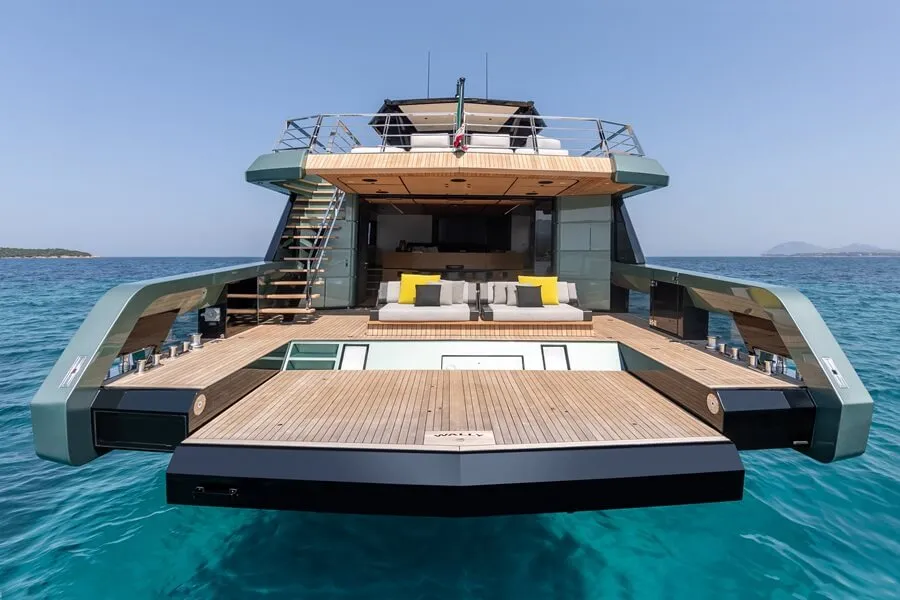
The aft terrace features a high-low platform that can deploy a tender up to 3.9m (12ft 8in) and has integrated steps to port. Just forward are fitted low sofas with adjustable backrests, so guests can enjoy the sea views including through the glass-panelled bulwarks, or face forward into the remarkable split-level saloon.
To port of the sofas are steps to a fantastic flybridge, the yacht’s other major outdoor social zone. Sheltered under the end of the hard top, an attractive three-sided sofa takes centre stage and faces a clean, aft deck that can be dressed with sunpads and loungers offering clear views through wraparound railings.
Forward of the sofa is a wide wet bar, which is flanked by Y-shaped hard top supports and serves a covered dining table offering breezy alfresco dining for eight. Most of the upper deck offers guests panoramic views, even forward, where the recessed pilothouse is set four steps down and feels like a different planet.

Featuring two high-backed, Poltrona Frau helm seats and three Simrad screens, the enclosed control room recreates the Darth Vader vibes of the wallywhy200’s wheelhouse, with an almost all-black décor only interrupted by a light daybed on port side. You can also enjoy a front-on view of the pilothouse from the foredeck, a working area accessed by a low door starboard of the dining table.
If the terrace on the sea and open flybridge are notable differences to the wallywhy200, the saloon is also different. In fact, the double-height saloon is not only a first for Wally but also Ferretti Group.
On most motor yachts, the aft platform is well below the cockpit, but on the wallywhy150 it’s on the same level as the saloon, so a vast indoor-outdoor terrace is created when all the doors electronically slide out of sight. When needed, stoppers can be raised to create a seaworthy barrier.

“This is the first vessel with direct access to the sea at cockpit level with no stairs necessary,” says Bassani, Wally’s Chief Designer. “It’s effectively a floating loft on the water.”
The interior by Studio Vallicelli Design immediately stands out due to a 2.5m-high, ribbed-teak ceiling that rises like a wave above the saloon’s upper level, which is reached by four steps on either side. The lower and upper levels can feature an array of furniture and Ferretti Group has already designed multiple arrangements.
The lower level has an oblong dining table on hull one, a wide bar with bar stools for an upcoming US delivery, and low-slung loungers for the second Asia-bound hull, which has the dining room in the forward suite. De Vivo’s own ideas include bringing the outdoor vibe inside and continuing the unpolished teak decking into the lower level.

The upper level typically features an aft-facing sofa or sofas. On hull one, a large Edra sofa offers guests views of the aft terrace and sea, plus a central cabinet with a retractable, double-sided TV.
“As the beach club is on the same level as the saloon, it becomes so much more useable as you’re fully engaged with everyone inside. Even on the upper level, you’re overlooking the beach club and sea,” he says. “There are so many ways to arrange the saloon, so you almost want to have three or four boats just to try them all.”
In the forward bulkhead, a central door leads to a four-sided galley, the laundry facilities and stairs down to two crew cabins with en-suite bathrooms in the bow. The galley can also be designed in an open style, visible from the saloon.

The upper saloon also has a starboard door to the master suite, where a long hallway by the windows passes cupboards in fluted panelling before the door to the near full-width, twin-sink bathroom. Going beyond the bathroom door leads to one of the wallywhy150’s ‘wow’ moments.
Described as an “amphitheatre of the sea”, the symmetrical, spaceship-style bedroom offers spectacular views through windows wrapped around the bow and both sides of the room.
“All visitors love it, especially the ladies. They say, ‘Wow, yeah, I like this’,” Bassani smiles. “If the wives or girlfriends like it, then it’s a very positive sign.”

The guest cabins are on the lower deck. The standard layout includes two en-suite cabins midships, with an inward-facing double bed to port and forward-facing twins to starboard, while the forward,
full-beam VIP has a bed facing port to a large bathroom. Wally also offers the option of two full-beam VIP cabins by combining the space of the two midships cabins.
Overall, the wallywhy150 features many of the best bits of the wallywhy200, but offers a novel way to live on the water, with a huge aft terrace leading straight into a game-changing, double-height saloon.
“We tried to make the wallywhy150 a bit different from the wallywhy200 and we’re happy we had the chance to change the concept a bit,” Bassani says. “We needed something smaller as the wallywhy200 was too big for some people walking onto an 88ft motor yacht because it has the space of a 115-footer.

“A lot of people prefer the wallywhy150, but that’s expected because the wallywhy200 was the first to introduce the look and concept of the wallywhy series, so people understand it better and are more familiar by the time they see the wallywhy150. There are many reasons why the wallywhy150 is so popular.”
Photos by Gilles Martin-Raget & Toni Meneguzzo
www.wally.com
www.ferrettigroupasiapacific.com
This article was first published on yachtstyle.co.
For more on the latest in luxury yachting stories, click here.
The post Wally Shows Why in Asia appeared first on LUXUO.