
from Men's Gear


The Malaysian-based purveyor of extraordinary jewellery HABIB has just unveiled HARTA. HARTA which stands for Habib: Action for Revival of our Traditions Arts, is an initaitive of the renowned jeweller to celebrate Peranakan cultural roots and art. While Habib is renowned for their exquisite craftsmanship, the company also maintaints its commitment to preserving and revitalising Malaysia’s traditions and arts. With deep-rooted pride in its Penang origins, Habib aims to educate and engage the public on the opulence of Malaysian culture. HARTA is divided into three components. First, the museum which highlights the gilded traditions of the multi-ethnic Peranakan heritage, with over 800 unique pieces collected over 65 years. Next, the art gallery which compliments the HARTA Museum, operates as an outlet to spotlight the works of contemporary Malaysian artists and artisans showcasing exclusive artworks from 16 talents. This is followed by the café which is where visitors can unwind and taste delicious treats while engaging in discussions about Malaysian culture – past and present.
LUXUO speaks exclusively to Mirsham Meer, Director of HARTA on his passion for contemporary Malaysian art scene, the conceptualisation of HARTA and how he aims to reinvigorate the younger generation on local cultural heritage and the arts.
Growing up my parents exposed us to the arts, particularly Malaysian art, from a young age. They have been collecting for as long as I remember and have formed close relationships with some artists.
They have always been very proud Malaysians and serious about preserving our Malaysian history. They want the future generations of Malaysia to understand our culture, traditions and history.
This year marks HABIB’s 65th anniversary, and when thinking about what we want to achieve with the brand (beyond our financial goals), we decided we wanted the brand to help Malaysians build more pride in our country, and we thought to do this through educating and exposing younger Malaysians to our traditions and arts – so HARTA was born.

Absolutely! My grandfather started the business 65 years ago and played a role in how the jewellery industry was shaped in Malaysia, particularly in the Northern states like Penang, Kedah and Kelantan.
He was a proud Malaysian and would have loved to see our traditions and heritage continue onto the younger generations.
In addition to the exposure we had growing up, I lived in the United Kingdom for a number of years where I was exposed to some of the greatest artworks in history (the Tate Modern was literally a 10 minute walk from my university). This is where I got really excited about the art world. It became an obsession. Moving back to Kuala Lumpur in 2019, I wanted to really get to know the art scene here and get to know gallerists and artists. It also felt like a really interesting time to be part of the scene as there were a lot of younger people getting into the scene – as artists, gallerists, collectors, or just enthusiasts. New galleries were popping up every few months, there were new shows to go to every weekend. It was really exciting!

We have two main aims for our gallery space:
Therefore, when considering what shows and programming to do for the space, we keep in mind that the show has to be simple, easy to understand and attractive for new art enthusiasts. We want to exhibit both emerging and established artists – for different reasons. We feel that giving more exposure to emerging artists can help build their careers, but also exhibiting more established artists can be interesting for people to see and also to inspire young artists.
We want younger Malaysians to be more excited about our heritage and our arts – as I mentioned earlier, we want to help build up pride in our country, particularly amongst younger Malaysians.
Our country is so rich in history, and our cultural history is so diverse. Additionally, we have so many fantastic artists telling their own stories through their art. I truly believe a lot of our artists are world class but just haven’t had the opportunities to step up to that level. We are hoping that whatever we are doing can help contribute to that next stage of growth for Malaysian art.

At our gallery, we don’t curate the shows ourselves as we prefer working with external curators and galleries who have a more discerning eye in the art scene. Our first show was curated by Aminah Ibrahim, a freelance curator in KL (previously with A+ Gallery).
HARTA’s first exhibition is called Open House. The exhibition explores Malaysian domestic spaces as inspirational and aspirational, offering a closer look at the treasure of everyday. It features multimedia work by artists Azzah Sultan, Bayu Atom Radjikin, Chong Yan Chuah, Fawwaz Sukri, Gan Tee Sheng, James Seet, Nadirah Zakariya, Raimi Saini, Umi Baizurah, Yuki Tham as well as works from HARTA’s own collection by Ahmad Zakii Anwar, Atiqah Khairul Anwar, Ismail Awi, Jalaini Abu Hassan, Lee Long Looi and Yee I-Lann. The exhibition, much like a home, is divided into several “rooms”: Kitchen, Living Room, Bedroom and Garden, with each room investigating different arenas of domesticity. Guests are invited to roam as they please and delve into the many narratives, objects, technology, emotions and histories displayed by the artists.
Open Houses hold significance in Malaysian culture where we welcome family, friends and acquaintances into our home. It felt important to introduce HARTA in a way that was accessible and welcoming.
Najib Ahmad Bamadhaj is such a fantastic artist and I’m a big fan of his work. We commissioned him to create the “Kebaya Series”, a special artwork featuring three models of different races wearing traditional Kebayas and Peranakan jewelleries that are part of our museum collection. The kebaya is such a unique yet universal part of our culture because anyone can wear them, so we felt this was a great metaphor of what HARTA stands for – a creative space for all Malaysians to appreciate our art and traditions. It is a mixed art piece that incorporates charcoal, acrylic paint, kebaya cloth collages and Meranti board – all materials which bring its own identity and personality. It’s also one of the first artworks you see when you enter HARTA.
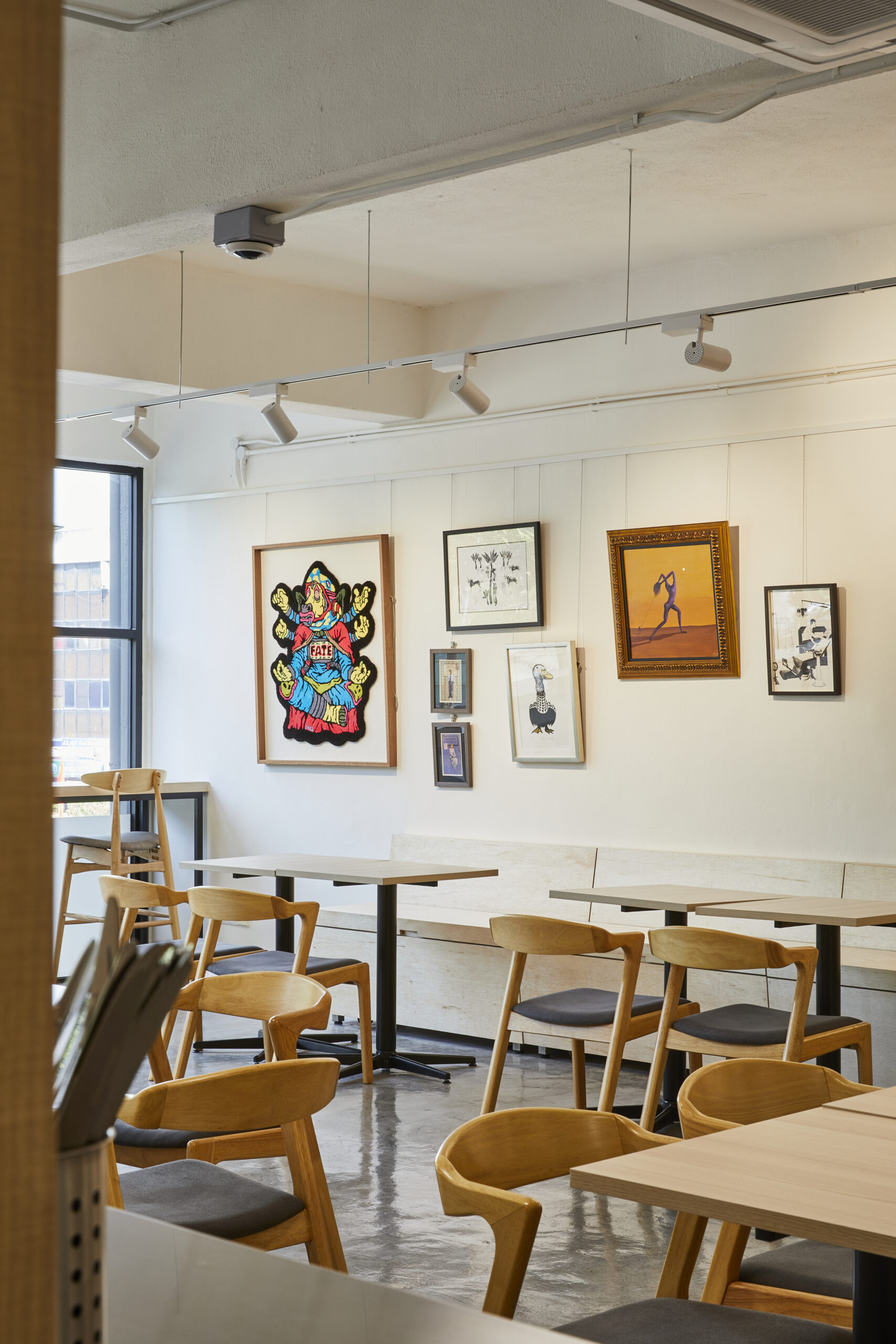
HARTA Café is a little café within our space. It serves specialty coffee, matcha, chocolate and some pastries and sandwiches too. The space serves a couple purposes such as being a hangout space for gallery/museum visitors to chill after browsing; and also to attract people to come up to the space and hangout. By attracting visitors to the café, we hope that those visitors will pop into our gallery or museum spaces after.
In the café, we also feature artworks from Malaysian artists rotating every few weeks. The artworks aren’t curated to any particular theme, but more just fun artworks that we like and want our customers to see.

We have a series of shows and educational events planned. We will partner up with other galleries and institutions to provide a wide range of shows including solo shows for emerging and senior artists. We also plan to have educational workshops and talks covering topics around Malaysia history, culture, fashion, film and many more!
Do I have to pick one? To be honest, there are so many amazing museums in Malaysia – public and private.
Of course, our Muzium Negara is fantastic and I encourage everyone to drop by when they visit. The Islamic Arts Museum in KL and the Borneo Culture Museum in Kuching are also both amazing! Must visits!
Again, so much to choose from!
I think the Ilham Gallery is fantastic. The quality of the curation is world class and I love that we have an institution like that in Malaysia. For those that want to see more Malaysian artists, the National Art Gallery, Bank Negara Malaysia Museum, G13 Gallery and Rissim Contemporary are really interesting. A+ and Taksu feature regional artists and their shows are also superb. Lastly, there are some amazing private collections on display in galleries like UR-MU and Galeri Z.

I can’t say one without the other, but I’d definitely say my parents. Not only because of their dedication to this project, but throughout my life they’ve been amazing examples of how to work hard to achieve success, whilst remaining humble and completely down to earth. Their kindness and dedication to the people around them is very inspiring and I hope that through our work, we not only preserve our Malaysian heritage and traditions, but also preserve their legacy that they’ve built together.
Address: Habib Jewels Sdn Bhd, Lot 93-95, Ampang Point, Lorong Mamanda 2, 68000 Ampang, Selangor.
Opening hours:
HARTA Museum & Art Gallery: 10AM – 5PM (Monday – Sunday)
HARTA Café: 8.30AM – 5PM (Tuesday – Friday), 10AM – 5PM (Saturday – Sunday)
For more on art features and exclusive interviews, click here.
The post Mirsham Habib on HARTA’s Initiative to Celebrate Malaysian Art and Culture appeared first on LUXUO.



Branded as “the first Western virtual influencer to have achieved global success” Lil Miquela made her debut on Instagram in 2016. Named Miquela Sousa or Lil Miquela, she fascinated many with her human-like appearance causing many to speculate if she was a marketing stunt, based on a real person, or something else entirely. Trevor McFedries and Sara DeCou of robotics and AI firm Brud, announced they were behind Lil Miquela in 2018. Amassing some 2.7 million followers on Instagram, the self-proclaimed 19-year-old robot Miquela is perhaps the world’s first (and most famous) AI influencer. She joins a growing trend of virtual influencers. This year, Lil Miquela signed with CAA and is projected to earn over USD10 million. As Forbes puts in plainly, someone who doesn’t exist is more successful than you. Let that sink in.

However despite the recent success, some reports state that Lil Miquela seems to have lost her splendor. Her TikTok account has been inactive since November 2022, her YouTube channel hasn’t been updated in two years, and her Instagram account only posts three times a month, with a significant drop in fan engagement. LUXUO dissects what brought on the fall of the virutal influencer.
Oftentimes, the ethics of these Ai-generated characters come into play. Case in point, Shudu Gram. Shudu was a black C.G.I. model created by the white fashion photographer Cameron-James Wilson around 2017. By 2019 Shundu had been featured on WWD, Vogue and fronted campaigns for Balmain and Ellesse. However, Shudu would later be labelled as a form of “digital blackface” with creator Cameron-James Wilson being heavily criticised for profiting off of a Black model’s digital career. Where Shudu faced backlash for blackface, Miquela had her fair share of controversy of queerbaiting in a 2019 Calvin Klein advertisement. In the video campaign, Miquela shares a kiss with supermodel Bella Hadid causing fans to accuse the brand of using and sexualising Miquela. That same year Miquela faced online backlash after releasing a vlog in which she talked about her “experience” with being sexually assaulted.
“Sure enough, I just feel this guy’s cold, meaty hand touch my leg as if he was confirming I’m real. His hand literally lingers there rubbing my skin,” she said of the “creepy ass man” she was supposedly sharing a Lyft with. This caused many to be critical Miquela for co-opting real, tragic stories, especially as critics felt like the storyline was created in a bid to make Miquela appear more “real” and “relatable”.

According to marketingbrew, companies from Ogilvy to Balmain and Old Spice are looking to partner with virtual influencers—or in some cases, create their own. However, the rapid development of technology that’s often involved in creating them, including AI, is a space that is still being understood. While luxury brands may find virtual influencers tempting because brands have a have a lot more creative control, the digital landscape is constantly shifting and simply put, Miquela does not keep up. As a 3D animated character created in 2016, the advent of generative AI in recent years has disrupted the digital landscape and in doing so, created more sophisticated images, texts, sounds or videos which are getting increasingly harder to distinguish from reality. One could argue the technology used for Lil Miquela is outdated. The technology used to create an virtural influencer in 2021 would already be outdated.
Celebrities are also moving towards AI. Meta is paying one top creator as much as USD 5 million over two years for six hours of work in a studio to use their likeness as an AI assistant. For example, Kendall Jenner’s likeness is used for Billie, who is portrayed as a big sister to give users advice. And Tom Brady plays Bru, a chatbot for debating sports. Billie (not Kendall) is one of Meta’s 28 AIs that can communicate with you on Instagram, Messenger, and WhatsApp.
Miquela also stands for the fear-ridden idea that humans may be replaced with artifical intelligence. This is a TikTok trend we are already seeing as more “real life” influncers are impersonating “non-player characters” or NPC. Users livestream themselves acting like an “NPC” with pre-written dialogue—complete with nonsensical phrases like “ice cream so good” used in response to gifts given by their audience. As much as these robotic (and perhaps erotic) trends are confusing the internet, it is the influencers who are making the last laugh, taking in up to USD 7,000 a day for five catchphrases as reported by The Guardian. This begs the question, if Ai is already moving to more realistic virtual characters and “real life” influencers are acting like AI, does a virtual influencer from 2016 stand a chance?
For more on the latest opinion pieces, click here.
The post Opinion: Lil Miquela & The Fall of the AI influencer appeared first on LUXUO.
